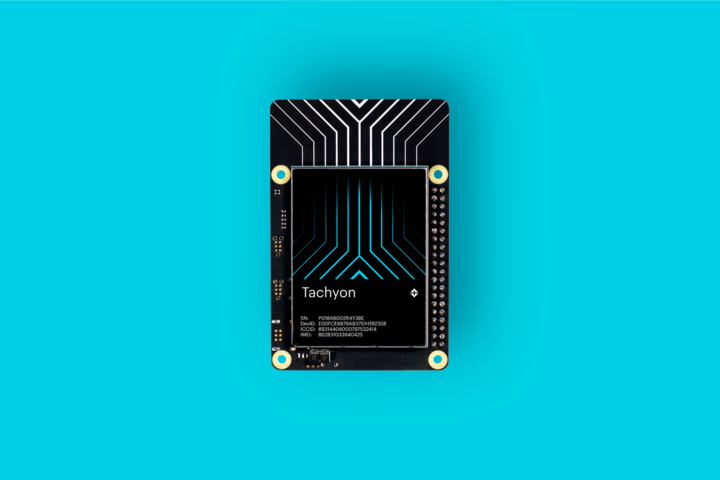
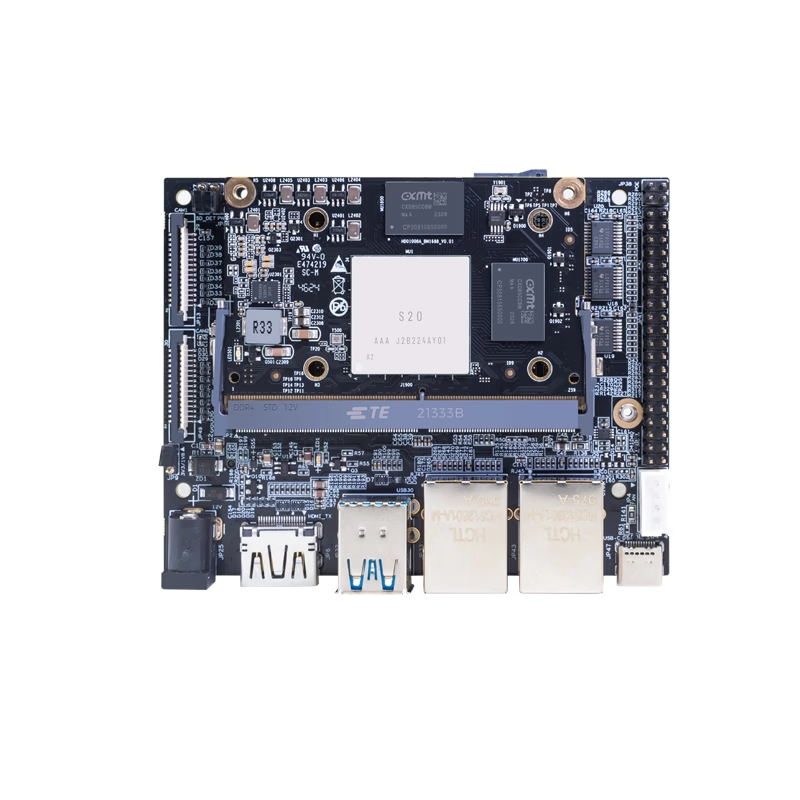
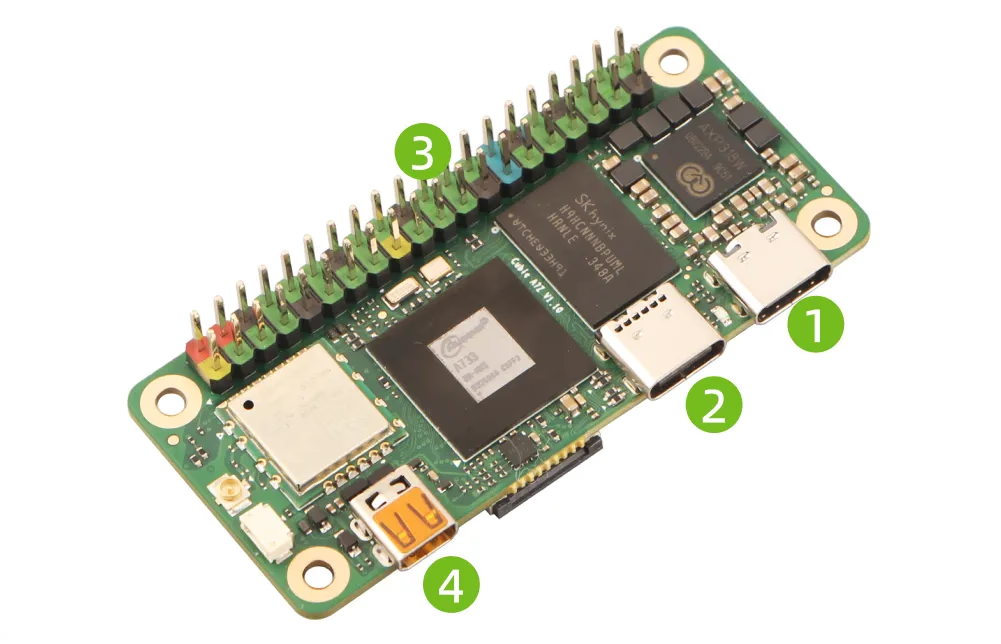
Particle’s “Tachyon” is a Single Board Computer (SBC) powered by the Qualcomm QCM6490 (equivalent to the Snapdragon 778G) that packs 5G connectivity, a 12TOPS NPU, and battery operation capabilities into a Raspberry Pi-sized form factor.
Described as “packing the insides of a smartphone into the shape of a Raspberry Pi,” its defining feature is the integration of cellular and Wi-Fi antennas directly onto the PCB. This eliminates the need for external modems or antenna wiring, making it highly attractive for engineers planning outdoor Proof of Concepts (PoC) or field deployments.
Pricing starts at $249 (approx. ¥37,000). By omitting HDMI and wired LAN in favor of 5G and battery support, this product is clearly targeted at those who want to build “devices to be placed in the field.”
Specs
| ■ Particle Tachyon | |
|---|
| SoC | Qualcomm QCM6490 (Kryo 670 8-core, up to 2.7GHz) |
| GPU | Adreno 643L |
| NPU | Hexagon 770 (12 TOPS) |
| Memory | 4GB / 8GB LPDDR5 |
| Storage | 64GB / 128GB UFS builtin, microSD slot |
| Network | 5G Sub-6 (eSIM builtin), Wi-Fi 6E, Bluetooth 5.2 |
| Video Output | USB-C (DisplayPort Alt Mode, 4K@60Hz) |
| Camera Input | MIPI CSI 4-lane x2 (22-pin 0.5mm) |
| USB | USB-C 3.1 (PD/DP support), USB-C 2.0 |
| Expansion | 40-pin GPIO (RPi compatible), PCIe Gen3 x1, Qwiic |
| Power | USB-C PD, Li-Po Battery (JST-PH) |
| Size | 85x56x18.5mm / 55g |
| OS | Ubuntu 20.04/24.04, Android 13 |
| Accessories | Battery (3100mAh), Audio Board |
This is a 5G-capable SBC that condenses a 5G Sub-6 modem, 12TOPS NPU, Wi-Fi 6E, and battery management circuit onto a PCB measuring just 85x56mm, the same size as a Raspberry Pi.
Features
SoC: CPU and NPU
The heart of the Tachyon is the Qualcomm QCM6490. This silicon is almost equivalent to the Snapdragon 778G/778G+, an octa-core processor manufactured on a 6nm process.
The CPU cores use the “Kryo 670” architecture with the following 3-cluster configuration:
- Prime Core (1): Cortex-A78 based @ 2.7GHz
- Performance Cores (3): Cortex-A78 based @ 2.4GHz
- Efficiency Cores (4): Cortex-A55 based @ 1.9GHz
Even compared to the Rockchip RK3588 (Cortex-A76x4 + A55x4), which is considered top-class in the SBC world, the Tachyon holds an advantage in both architecture generation (A78 vs A76) and clock speed. Its single-thread performance reliably exceeds that of the Raspberry Pi 5 or Orange Pi 5, making it suitable for running multiple containers or handling communication and inference simultaneously.
The NPU is the Hexagon 770 DSP, boasting 12 TOPS of computing performance. Since the Raspberry Pi 5 has no built-in NPU (requires AI Kit for 13TOPS) and the RK3588’s built-in NPU is 6TOPS, the Tachyon possesses nearly double the AI inference performance of its competitors “out of the box.” The official documentation claims it can run AI models while capturing high-resolution video from two cameras, suggesting high potential for surveillance cameras and robotics applications.
However, utilizing Qualcomm’s AI accelerator requires the “Qualcomm AI Engine Direct SDK (QNN SDK),” and setting it up on Ubuntu seems to involve manual installation and path configuration. Compared to the ease of “apt install” on a Raspberry Pi, there are still some rough edges for developers.
5G Connectivity (The True Value)
What decisively sets the Tachyon apart from other SBCs is its standard built-in 5G communication module. The back of the board features a Quectel “SG560D” series 5G smart module, which has a System-in-Package (SiP) structure containing the QCM6490 SoC.
- 5G Sub-6GHz Support: Capable of high-speed communication with up to 2.5Gbps downlink.
- Built-in Antennas: Cellular and Wi-Fi antennas are embedded directly on the PCB. No more “spaghetti wiring” of external antennas.
- eSIM (EtherSIM) Equipped: Provides a “just turn it on and connect” experience in over 40 countries worldwide.
Usually, using LTE with an SBC requires stacking a modem HAT and wiring external antennas, but the Tachyon connects right out of the box. This all-in-one design is a powerful advantage in reducing the risk of failure during field deployments.
There are two variants: one for North America (NA) and one for the rest of the world (RoW), with Japan included in the supported country list. Particle also offers a data plan starting at $6.99/month (approx. 999 yen), making operation in Japan a realistic option.
Power & Battery
Since it uses a chipset derived from smartphones, it has excellent compatibility with battery operation. The board features a 3-pin JST-PH battery connector, allowing direct connection of a 3.7V Li-Po battery. The product comes with a 3100mAh battery, so you can start mobile operation without additional purchases, which is a nice touch.
With a built-in charging circuit, it’s easy to build a UPS system powered by USB-C or a completely off-grid system combined with solar panels.
There are three power input sources:
- USB1 (Main USB-C): Supports USB PD, 9V/3A recommended.
- 40-pin Header 5V Input: Requires at least 5A. Insufficient current risks brownout. USB1 function is lost when powering via header.
- Li-Po Battery: 3.7V, JST-PH connector.
The note that USB1 functionality is lost when powering via the header implies that the power architecture needs to be decided at the design stage. Conversely, it’s helpful that such caveats are clearly stated officially.
Thermal design assumes fanless operation, with the RF shield on the back of the board doubling as a heat spreader. The operating temperature is -17 to +65°C, with thermal shutdown listed at -20 to +70°C.
Storage & Boot
The board comes with 64GB/128GB of UFS on-board. Official guidance states “OS is stored on internal flash, SD card is for additional storage.” Not booting from microSD is a good design choice that avoids worries about lifespan and speed.
It also supports NVMe expansion via PCIe. A dedicated flexible cable connector brings out PCIe Gen3 x1, allowing connection of SSDs via an NVMe HAT or similar.
Expansion (RPi Compatible but Beware of “Traps”)
This is the point requiring the most attention with the Tachyon. While it claims “Raspberry Pi form factor,” there are unique changes to the connector specifications.
Camera/Display Connectors (CSI/DSI) are the biggest “trap.” The Tachyon uses 22-pin 0.5mm pitch connectors for CSI/DSI. The standard “15-pin 1.0mm pitch” ribbon cables used on Raspberry Pi (excluding Zero series) will not physically plug in. If you plan to reuse existing Raspberry Pi cameras, you’ll need conversion cables and to check compatibility.
GPIO features a Raspberry Pi-compatible 40-pin header, but the voltage is 1.8V/3.3V and is not 5V tolerant. Connecting old 5V HATs or sensors directly carries a risk of immediate damage, so level shifters are required.
Video Output has no HDMI port. It supports up to 4K@60Hz via USB-C (DisplayPort Alt Mode), but a conversion adapter is essential to use older HDMI monitors.
For use in Japan, the biggest concern is the “Giteki” (Technical Conformity Mark).
The Quectel SG560D module mounted on the Tachyon reportedly has certification for major Japanese carriers (Softbank, KDDI, Docomo). Also, “Japan” is included in the supported country list on Particle’s official site, and a monthly data plan is offered.
However, to use it legally as an SBC in Japan, the product itself needs the Technical Conformity Mark. Until the mark is confirmed on the actual unit, we consider it “unconfirmed.” When purchasing, choose the “ROW (Rest of World)” version, and be sure to check the mark on the back or packaging upon arrival.
Summary
The Particle Tachyon is a very sharp SBC that crams “smartphone-class SoC + 5G + 12TOPS NPU” into a Raspberry Pi 5 form factor. By cutting HDMI and wired LAN to go all-in on 5G, battery, and eSIM, it appeals to those who want to build “terminals to place in the field” rather than a desktop NAS.
It’s perfect for uses like “AI processing and cloud communication where there is no Wi-Fi,” such as remote gateways via 5G, edge AI terminals combining cameras and inference, or field devices logging via NVMe. The value of an all-in-one design with built-in antennas, no wiring, and easy integration into waterproof cases is immeasurable for engineers conducting PoC in the field.
On the other hand, there are traps if you think of it as a “Raspberry Pi replacement”: no HDMI makes it unsuitable for desktops, CSI/DSI connectors are incompatible with RPi standards, and GPIO is not 5V tolerant. Prior confirmation is needed to see if you can reuse your existing peripherals.
| Seller | Price (Reference) |
|---|
| Official Store (4GB/64GB) | $249 (approx. ¥37,000) |
| Official Store (8GB/128GB) | $299 (approx. ¥45,000) |
*Shipping to proper destination is separate.