IBASE offers the IBR300, a 2.5-inch SBC powered by the NXP i.MX 93. The official product page provides specifications including I/O and environmental conditions along with images.
The announcement date and release date could not be confirmed from official primary sources.
The IBR300 adopts the i.MX 93 (Arm Cortex-A55 dual-core + Cortex-M33) and is designed as an “embedded device-oriented” board with Yocto 5.0 as the assumed platform. The standout features are dual GbE and locking 12-24V input available right out of the box.
However, the public product page alone does not clarify M.2 wiring (PCIe or USB, generation, lanes), boot switching/recovery procedures, or mounting hole positions. If you plan to adopt this board, it’s safer to obtain datasheets or contact the manufacturer to confirm the prerequisites.
Specifications
| ■ IBASE IBR300 | |
|---|
| SoC | NXP i.MX 93 (Arm Cortex-A55 dual-core up to 1.7GHz) |
| MCU | Arm Cortex-M33 (up to 250MHz) |
| NPU | Arm Ethos-U65 microNPU (256 MAC, up to 1.0GHz, 2 OPS/MAC noted) |
| GPU | PXP (for 2D image processing) |
| Memory | 2GB LPDDR4 (onboard) |
| Storage | eMMC 32GB (onboard, up to 256GB noted) and microSD slot |
| Wired LAN | RJ45 1GbE 2 ports |
| Video Output | LVDS 1 channel, MIPI-DSI 1 channel (1080p60 MIPI-DSI, 720p60 LVDS noted) |
| USB | USB 2.0 Type-A 2 ports (internal USB 2.0 header noted) |
| Expansion | M.2 E-Key 2230 (for Wi-Fi/Bluetooth), DIP switch |
| Internal I/O | Debug COM, COM (RS-232) 2 channels, CAN FD 2 channels, I2C/UART, Audio, RTC battery, DC power, etc. |
| Operating Temperature | -40 to +85°C (fanless design noted) |
| Power | 12-24V DC input (locking jack). Internal power header noted |
| Supported OS | Yocto 5.0 (official). Other OS support available upon request |
| Dimensions | 105×72mm |
This is an industrial 2.5-inch SBC combining i.MX 93 (A55+M33) and Ethos-U65 microNPU with dual GbE, 12-24V locking power supply, and fanless design for wide temperature operation.
On the other hand, M.2 wiring specifications and detailed boot operation cannot be confirmed from the public page alone, so it’s practical to plan for verification before adoption.
Features
SoC/CPU and MCU (i.MX 93)
The core of the IBR300 is the NXP i.MX 93. Linux applications run on the Cortex-A55 side, while device control and timing-critical processing can be handled on the Cortex-M33 side, making role separation easy to design.
This suits environments where maintainability and long-term operation requirements drive system partitioning rather than simply seeking a “faster CPU.”
For AI capabilities, the Ethos-U65 microNPU (256 MAC) is documented. This is positioned less as competing for high TOPS numbers and more as an option for integrating lightweight inference as a feature.
However, supported frameworks, measured performance, and expected models are difficult to assess from the public page alone, so software stack verification is necessary when finalizing implementation.
Competitive alternatives include general-purpose SBCs like Raspberry Pi with external accelerators, or evaluation kits and module (COM) variants from the same SoC family. The IBR300’s differentiator is that power, temperature range, and dual GbE are already configured for “field deployment” out of the box.
Power and Thermal (Fanless, Wide Temperature)
Power input is 12-24V DC with a locking jack as standard. Internal power headers are also mentioned, indicating a design conscious of chassis integration.
Operating temperature is a wide -40 to +85°C, and fanless design is explicitly stated. While this is reassuring, how heat is dissipated inside a chassis (thermal path, airflow, heatsink contact area) depends on on-site implementation, so thermal design requires separate consideration.
Storage and Boot (eMMC, microSD)
Storage includes 32GB eMMC (onboard) plus a microSD slot. This configuration lends itself to development with microSD initially, then switching to eMMC for mass production.
However, no official URL was found for boot switching or recovery procedures. While DIP switches are mentioned, their purpose and operational procedures should be confirmed before adoption.
Expansion and Compatibility (M.2 E-Key and Internal I/O)
The M.2 slot is E-Key 2230, clearly intended for Wi-Fi/Bluetooth modules. However, whether M.2 connects via PCIe or USB, and PCIe generation or lane count—information critical for compatibility—cannot be determined from the public page alone.
If this affects your requirements, it’s safer to obtain datasheets or contact the manufacturer to confirm wiring specifications.
For GPIO, rather than expecting a general-purpose 40-pin compatible header like hobby SBCs, it’s better to think of this as a design that exposes internal I/O (I2C/UART, CAN FD, multiple COMs, Audio, etc.) via pin headers.
Network and Video Interfaces
With two RJ45 1GbE ports, configurations that “use two LAN connections” such as in-device relay or compact gateway setups are easy to create—a clear strength.
Video output is LVDS and MIPI-DSI, differing in approach from general-purpose SBCs that assume HDMI. This design suits embedded panel connections but is less suitable for casual verification on a desktop HDMI monitor.
Appearance
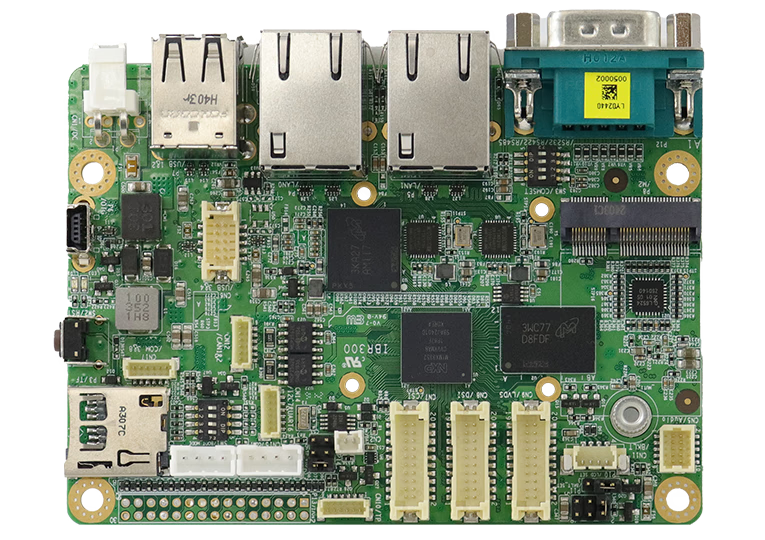
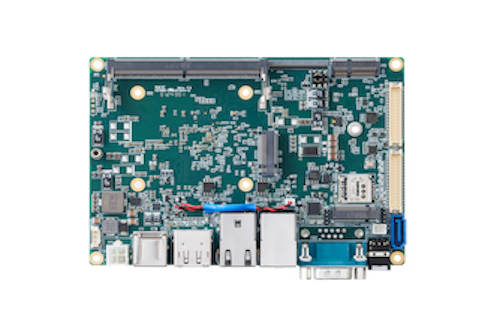
This is a compact 2.5-inch class board with connectors placed along the board edge, showing a layout designed for embedded device integration. It’s also useful for confirming M.2 (E-Key) slot and microSD slot positions.
No image of the board bottom (BOTTOM) was found on the official page.
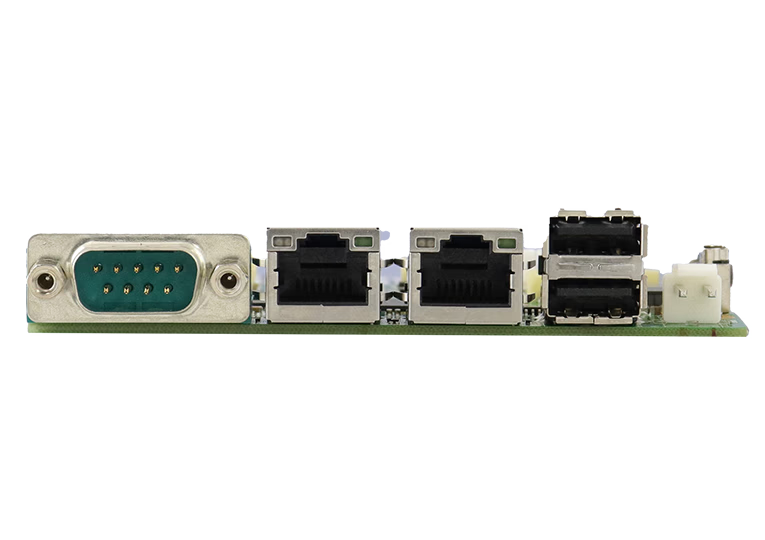
The two RJ45 ports, USB Type-A, and locking DC input are consolidated on one side, making wiring design straightforward. For COM (RS-232/422/485) and other external breakouts, verify with the specification sheet rather than inferring from images alone.
Summary
The IBR300 is a 2.5-inch SBC that highlights the i.MX 93 (A55+M33) and Ethos-U65 microNPU while targeting robust industrial equipment operation based on Yocto.
The officially documented locking 12-24V input, dual GbE, and fanless wide-temperature support provide reassurance for embedded device integration.
However, M.2 wiring specifications, PCIe conditions, boot switching/recovery procedures, and mounting holes cannot be confirmed from the public page alone. This appears more as a component for those refining requirements and planning for mass production and maintenance rather than an “SBC for immediate casual use.”
Since an inquiry form (Inquiry Form) is provided, it’s practical to proceed while confirming design prerequisites with the manufacturer.
| Purchase Method | Price (Reference) |
|---|
| IBASE (Inquiry) | Not confirmed (quote consultation) |
| Authorized Distributors | Not confirmed |