PINE64 StarPro64: A RISC-V Model-A SBC with 20 TOPS-Class NPU and PCIe Gen3 x4 Expansion
PINE64 has listed the "StarPro64" on their official store. This RISC-V SBC is built around the ESWIN EIC7700X (Quad P550) and features an "AI-oriented" design with a stated NPU performance of 19.95 TOPS (INT8). However, the official Docs explicitly note that "the release is alpha and intended for development and testing," so evaluations assuming production-ready stability should be avoided at this stage.
PINE64 has listed the StarPro64 on their official store, with product information available on their official product page and Docs.
This RISC-V SBC is built around the ESWIN EIC7700X (Quad P550) and features an “AI-oriented” design with a stated NPU performance of 19.95 TOPS (INT8).
However, the official Docs explicitly note that “the release is alpha and intended for development and testing,” giving the impression that this is currently for those who enjoy “verification and bring-up” rather than “stable operation.”
DC 12V @ 3-5A (5.5mm/2.1mm center-positive barrel jack)
Supported OS
RockOS/ALPHA-One (alpha status)
This configuration places a RISC-V SBC with 19.95 TOPS-class NPU on a 133×80mm Model-A board with PCIe Gen3 x4 expansion and dual GbE.
However, the 12V power requirement, mandatory heatsink, and alpha-status OS are points to verify before purchase.
Features
SoC and CPU
The CPU is the ESWIN EIC7700X (Quad-core P550, up to 1.8GHz), based on RISC-V architecture. The GPU is the Imagination AXM-8-256 (up to 600MHz), and the NPU offers 19.95 TOPS (INT8), making this an AI-conscious configuration.
Importantly, the official Docs explicitly state that “the release is alpha and intended for development and testing.” This is not the stage for evaluations assuming software maturity for production use—it’s currently a product for those who want to enjoy bringing up a new RISC-V SBC.
The NPU claims 19.95 TOPS (INT8), positioning it in the 20 TOPS-class for AI performance. Competitors include the Raspberry Pi 5 + Hailo-8L (13 TOPS) and Orange Pi AI series (6 TOPS-class), but this product differentiates itself by having an “NPU built into a standalone RISC-V SBC.”
However, with the OS currently in alpha status, whether an environment ready to run NPU-accelerated inference pipelines is available is a separate matter. While the official Docs Software page has download links, the flashing procedure itself couldn’t be confirmed in official primary sources, so expect some trial and error for initial deployment.
Memory and Storage
Memory is 32GB LPDDR5 @ 6400MHz, quite generous for an SBC. RAM configurations of 8, 16, and 32GB are mentioned, but the official store lists the 32GB model (verify SKU notation when purchasing).
Storage options listed as bootable include XSPI NOR flash (16MB), microSD, and eMMC (PINE64 eMMC module). Having multiple options from a “just get it booting” perspective is advantageous.
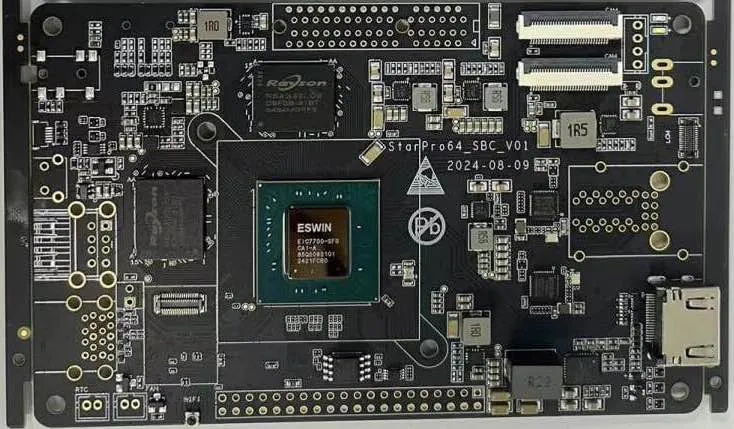
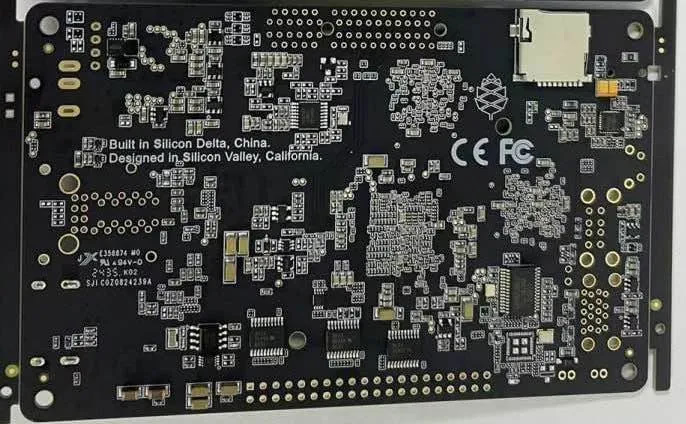
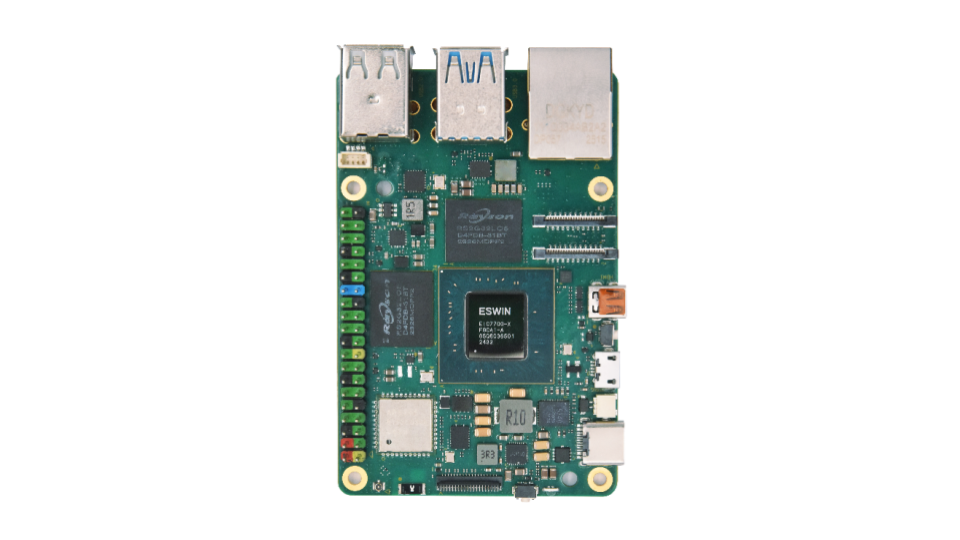
The form factor is the “Model-A” size at 133×80mm×19mm, weighing approximately 116g. The board’s top side shows dual RJ45, USB ports, video output connector, and power input (DC jack), with the PCIe Gen3 x4 open-ended slot also visible.
When considering thermal design, keep the official store’s “heatsink required” note in mind and plan case and cooling solutions considering both top and bottom surfaces.
Additional Details
Expansion
PCIe Gen3 x4 lane (open-ended slot) is confirmed in primary sources. For expansion requiring bandwidth (high-speed I/O, various accelerators, etc.), this makes an appealing “base station.”
On the other hand, M.2 (Key/size/purpose) is not explicitly stated in the official specs page expansion section and couldn’t be confirmed in official primary sources. If planning around M.2, you’ll need to design including conversion and mounting methods via PCIe.
GPIO is listed as a “Pi2” 2×20 pin header (equivalent to 40 pins). Avoid assuming pin compatibility (Raspberry Pi compatible, etc.)—confirming whether required signals are available requires cross-referencing pinout diagrams and schematics. UART connection examples include instructions to set USB serial to 3.3V level.
Networking
Wired connectivity is dual GbE, wireless is 2.4/5GHz Wi-Fi (802.11 b/g/n/ac/ax) + BT 5.3. This makes it easy to configure as a small edge device or test router/NAS-oriented setup.
Video output primary sources indicate “digital video output up to 4K@60Hz,” but connector type and effective limits depend on OS/drivers, so at this point, design conservatively rather than assuming output capability.
Power and Thermals
Power is DC 12V (3-5A), with 5.5/2.1mm center-positive barrel jack specified in primary sources. Those expecting Raspberry Pi-style 5V USB-C power should take note.
The official store notes “heatsink required,” so don’t assume bare operation—it’s safer to create an enclosure and cooling plan first.
Conclusion
The StarPro64 is an explicitly “developer-oriented” SBC featuring RISC-V (P550×4) plus a claimed 19.95 TOPS-class NPU.
With 12V power and the official store explicitly noting heatsink requirement, operation is a step more demanding than “Raspberry Pi style.” However, PCIe Gen3 x4 is indicated in primary sources, making it appealing as a base for expansion experiments.
That said, with alpha status explicitly noted in official Docs, the impression is that this is currently for those who can enjoy “verification and bring-up” rather than “stable operation.” It’s suited for developers wanting to try a new RISC-V SBC, or those wanting to start edge AI experiments with an NPU-equipped board. It’s not suited for those wanting to immediately run stable inference pipelines in production, or those wanting casual use with 5V USB-C power.
Pricing and availability: The 32GB model is listed at community price $249.99 on the PINE64 official store.
In July 2025, Canonical officially announced that ESWIN Computing's EBC77 Series now supports Ubuntu 24.04 LTS. This SBC features a 64-bit OoO RISC-V CPU and an in-house developed NPU, making the RISC-V + Ubuntu + AI combination a notable highlight. However, detailed specifications for I/O, power, and other aspects remain unconfirmed in official primary sources, so additional research is needed before deployment.
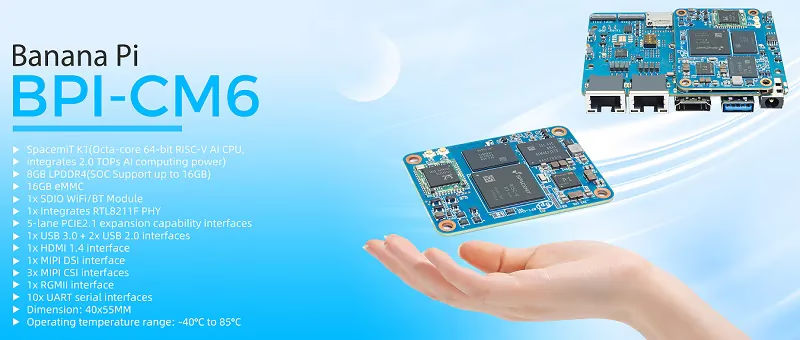
Banana Pi launched the BPI-CM6 public sales. Powered by SpacemiT K1 (8-core RISC-V), it's an industrial compute module balancing 2.0 TOPS AI and Raspberry Pi CM4 compatibility. A solid choice for starting edge inference with RISC-V.
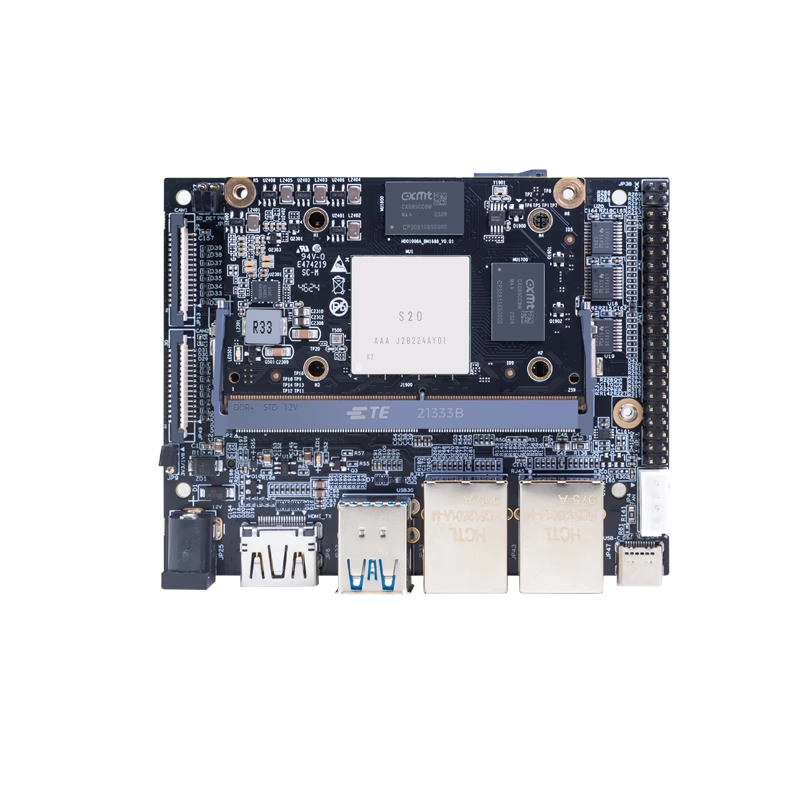
Banana Pi has released product information for their AI-focused core module "Banana Pi BPI-SM9". Equipped with SOPHGO BM1688 and rated at up to 16 TOPS (INT8), the official documentation emphasizes video analytics applications such as decoding and analyzing multiple HD video streams. However, there are inconsistencies in official sources regarding power (5V/12V), dimensions, and GbE port count, so verify whether you are purchasing the module alone, IO board, or kit before ordering.
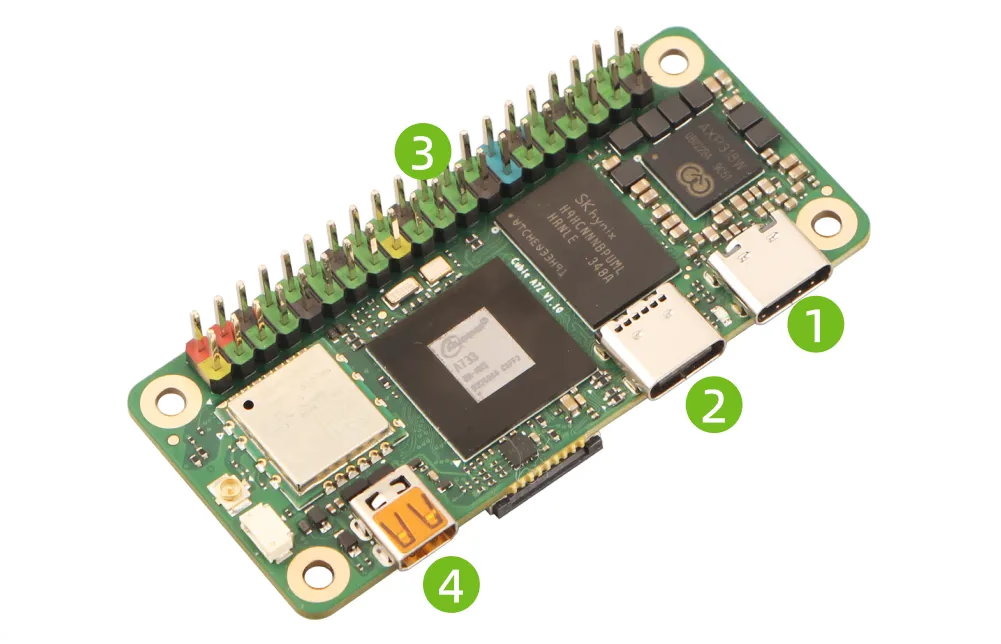
Radxa has published the product page and official documentation for the "Radxa Cubie A7Z." This ultra-compact SBC packs an Allwinner A733 (Cortex-A76×2 + Cortex-A55×6) and a 3 TOPS-class NPU into a 65×30mm form factor, complete with Wi-Fi 6 and Micro HDMI. However, wired LAN and M.2 require expansion, and PCIe is limited to Gen3 x1 via FPC, so checking whether it fits your use case beforehand is recommended.