Banana Pi BPI-Forge1: A Compact Industrial SBC Designed for Buildroot
Banana Pi (BPI team) has announced the public sale of the "Banana Pi BPI-Forge1." Powered by the Rockchip RK3506J (Arm Cortex-A7 triple-core), this compact SBC features dual 100MbE ports and control-oriented I/O. While it is clearly targeted at embedded use cases with Buildroot as the primary OS, the 512MB memory and some unconfirmed expansion specifications require careful consideration of your intended use case.
On May 16, 2025, Banana Pi (BPI team) announced the public sale of the Banana Pi BPI-Forge1. Product information is available on the official Docs and official forum.
This board features the Rockchip RK3506J (Arm Cortex-A7 triple-core), with dual 100MbE ports and RS485/CAN usage labels visible, indicating a compact SBC designed for audio, simple HMI, and industrial control I/O. The official OS prominently features Buildroot.
However, memory is a modest 512MB, and details like M.2/PCIe availability, GPIO voltage levels, and thermal design assumptions aren’t fully covered in primary sources alone. For mass production or continuous operation scenarios, you’ll want to verify the availability of additional information such as schematics, 2D drawings, and operating temperature specifications.
12V/2A (listed in Docs). USB-C power conditions unconfirmed
Supported OS
Buildroot (Kernel 6.1 etc.), RT-Thread, bare metal, Preempt-RT/Xenomai (mentioned)
Size
92×60mm (from image)
Accessories
Not listed (unconfirmed)
This is a compact 92×60mm SBC built around RK3506J + dual 100MbE + 12V power + Buildroot, solidly combining audio, simple HMI, and industrial I/O.
However, the 512MB memory and 100MbE networking are clear trade-off points—this board is not suited for NAS or high-bandwidth gateway applications from the start.
Features
SoC/CPU (Audio and HMI Focus)
The heart of the BPI-Forge1 is the Rockchip RK3506J (Arm Cortex-A7 triple-core). Rather than pushing the latest large-scale SoC, this design appears aimed at handling “on-site UI tasks” like voice interaction, audio I/O, and simple displays with a grounded approach.
This may not be flashy, but it’s the kind of design that quietly pays off. HMI applications often succeed when they “run stably,” “can be recovered,” and “have simple wiring.”
NPU/AI Performance (Competitor Comparison)
NPU inclusion could not be confirmed from primary sources (official Docs/forum announcement/official store listings). While there are mentions of 2D engines and display output engines, this doesn’t appear to be a board designed around inference accelerators.
For comparison, options like Raspberry Pi 5 + Hailo-8L (13 TOPS) or Orange Pi’s AI-focused SBCs (several TOPS class) exist as “inference-first choices.” The BPI-Forge1 is better suited for those who prioritize “on-site” work like control, audio, and simple displays over AI-oriented applications.
Memory and Storage (Check Recovery Paths First)
Memory is 512MB DDR3L, which doesn’t leave much headroom for GUI or container-heavy use cases. It’s more practical to commit to audio processing and control-oriented roles.
Storage is listed as 512MB (NAND) on the official store. Additionally, a microSD slot is provided, making microSD operation a viable option. The official Docs describe USB-C flash procedures (eMMC Boot) and microSD writing (microSD Boot).
However, the official store’s “NAND” listing doesn’t match the “eMMC” mentions in the official Docs. The exact onboard storage type remains unconfirmed, so this is worth clarifying before mass production.
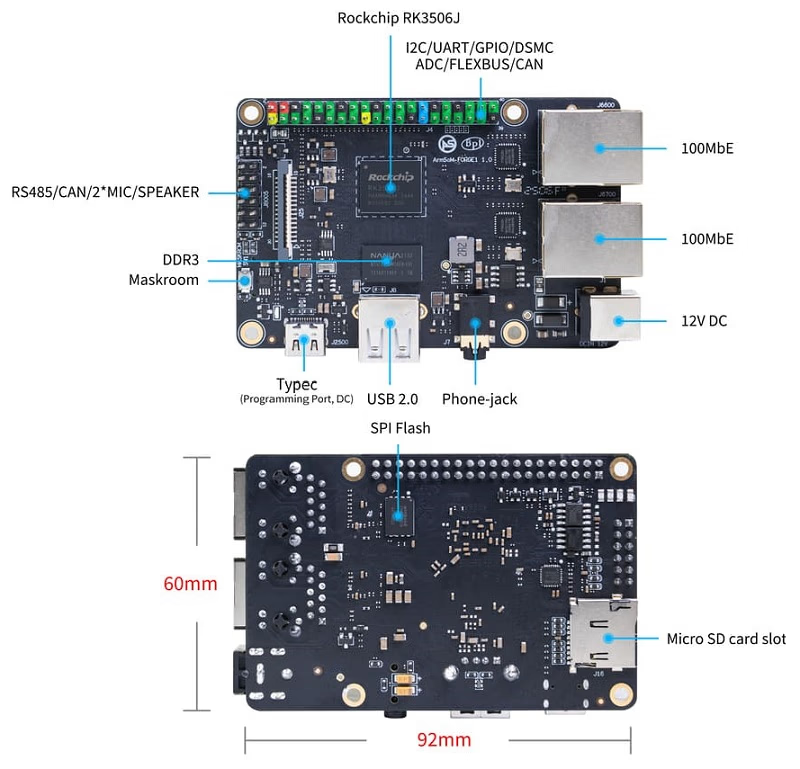
Also, Maskrom labeling is visible in images, which is relevant for recovery. Being able to recover when boot gets stuck is genuinely important for embedded use cases.
Networking and I/O (Dual 100MbE + Control)
The dual 100MbE configuration suggests a priority on “separating into two systems” and “maintaining physically solid connections” over raw bandwidth. This makes it easy to create configurations like a small gateway with WAN/LAN separation, or keeping equipment and upstream networks on separate systems.
However, 100MbE can become a bottleneck, making this unsuitable for streaming multiple image feeds or pulling large log volumes.
GPIO/Expansion (Compatibility Notes)
A 40-pin header is present, with I2C/UART/GPIO/ADC/CAN usage labels visible in images. However, detailed pin assignments and GPIO voltage (3.3V/5V) specifications that directly affect compatibility could not be confirmed from primary sources.
It’s safer to approach this as a “dedicated board” rather than assuming Raspberry Pi compatibility for drop-in replacement.
M.2 slots and PCIe also could not be confirmed from primary sources (unconfirmed). If you need expansion storage or high-speed I/O, you’d be better off considering a different class of SBC from the start.
Power and Thermal Design (For Mass Production/Continuous Operation)
Power is specified as 12V/2A in the official Docs setup section. USB-C is labeled “PD/Programming,” but PD voltage ranges and priority input specifications could not be confirmed from primary sources.
Additionally, thermal design information such as heatsink materials, operating temperatures, and enclosure assumptions were not found in primary sources. Industrial SBCs especially benefit from advance verification of in-enclosure temperature, airflow, and power quality assumptions, so for mass production or continuous operation, we recommend checking the availability of schematics, 2D drawings, and BOMs beforehand.
The upper portion of the image shows major components and terminals including the SoC (RK3506J), DDR3, 40-pin header, USB-C (Programming/PD label), USB 2.0, dual 100MbE, and 12V DC input.
This is useful for understanding the layout, but pin assignments and electrical specifications (such as GPIO voltage) cannot be determined from this image alone (unconfirmed).
BOTTOM (PCB Bottom Side)
The lower portion of the image shows the bottom-side implementation and microSD slot location. You can get a sense of component density and placement, but thermal pad specifications and temperature ratings were not found in primary sources (unconfirmed).
PORTS (Port Layout)
While not side-view photos, labels for dual 100MbE, USB 2.0, USB-C, 12V DC, and 3.5mm jack are visible.
The two-tier RJ45 arrangement and the 12V input being on the same side affect enclosure design and wiring planning. In field applications, this kind of “grouped terminal” layout can be a deciding factor for purchase.
Summary
The BPI-Forge1 prominently features RK3506J + Buildroot as its foundation, appearing as a compact industrial SBC aimed at solidly combining audio, simple HMI, and control I/O rather than flashy video output or high-speed I/O.
It’s well-suited for those who want to leverage dual wired LAN and control I/O to build gateways or audio/HMI terminals. It’s not suited for those who want “bandwidth or compute” to be the star, such as NAS, high-bandwidth networking, or local AI inference.
Prices and availability fluctuate, but the official store showed US$23.00 (last confirmed: December 29, 2025 JST).
Seller
Price (Reference)
Official Store (BPI-Shop)
US$23.00 (example listing; varies by configuration and availability)
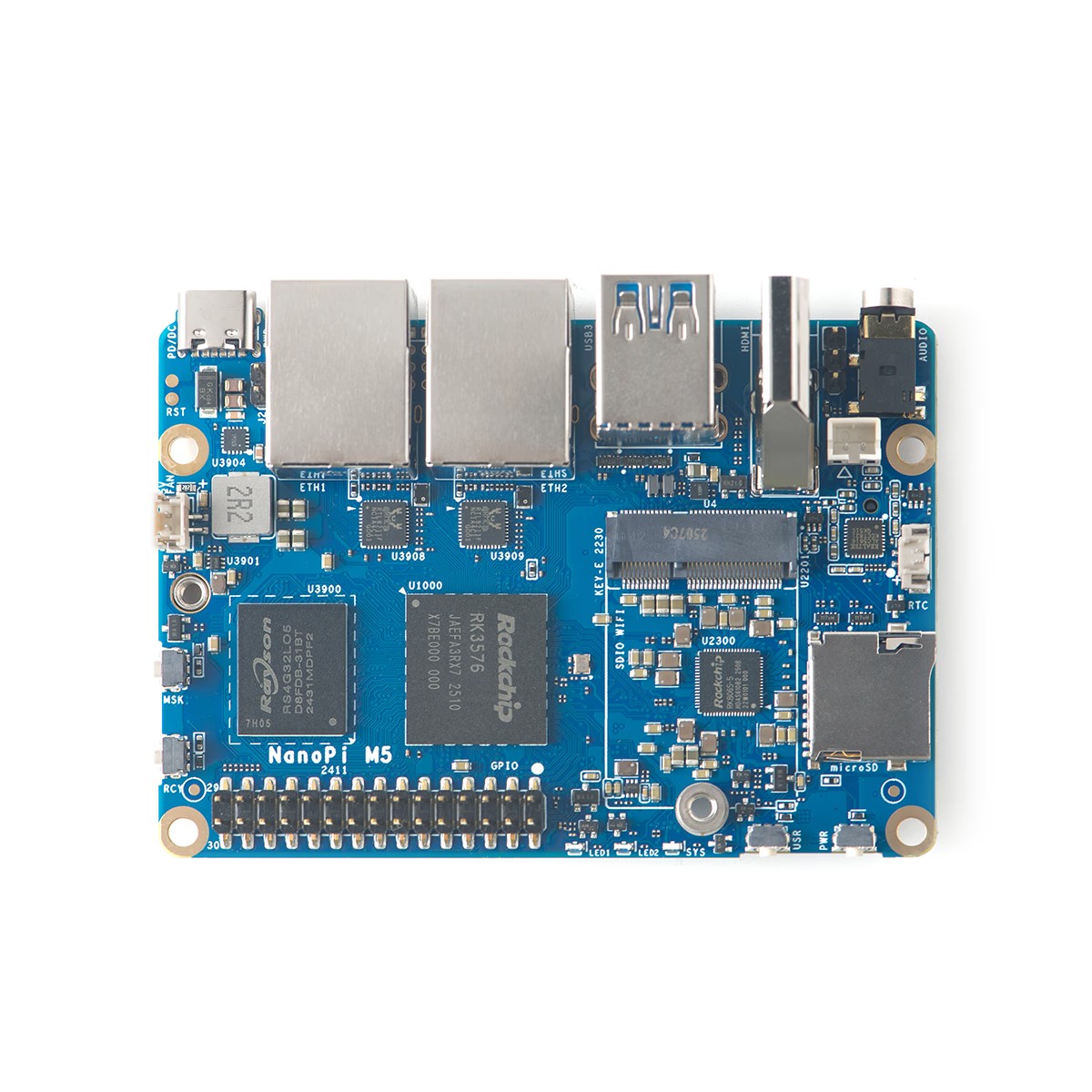
The NanoPi M5 from FriendlyElec is a compact 90×62mm SBC powered by the RK3576 with a 6 TOPS NPU, dual 1GbE ports, and an M.2 NVMe slot. With USB-C power input (6–20V, PD/DC), it offers flexible power options—ideal for router, NAS, or edge AI applications.
Banana Pi has released product information for their AI-focused core module "Banana Pi BPI-SM9". Equipped with SOPHGO BM1688 and rated at up to 16 TOPS (INT8), the official documentation emphasizes video analytics applications such as decoding and analyzing multiple HD video streams. However, there are inconsistencies in official sources regarding power (5V/12V), dimensions, and GbE port count, so verify whether you are purchasing the module alone, IO board, or kit before ordering.
Boardcon Embedded Design has announced the Boardcon Compact3576, featuring the Rockchip RK3576. This modular design separates the SoM and baseboard, targeting mass production and derivative board development. However, at the time of writing, official page information was insufficient, so verifying power, boot, and expansion details before purchase is essential.
youyeetoo has released the "youyeetoo R1". This AIoT-oriented SBC packs an RK3588S (8-core, up to 2.4GHz), 6TOPS NPU, and M.2 (NVMe/SATA) into a 100×69.3mm card-sized form factor. However, the revision (v3 or earlier) affects M.2 size support and USB 3.0 simultaneous use restrictions, so verification before purchase is essential.